Everise IMS​

Everise IMS is an integrated front-to-back solution, featuring open data model, open architecture, high degree of operational customisability, agile development and full compliance with local regulations. Please explore key Everise IMS features below.
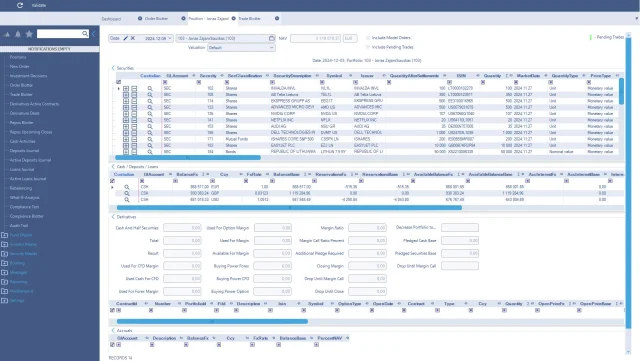
Open Architecture

Everise IMS open data model ensures that clients retain ownership of data by fully disclosing data structures, providing easy access to the entire dataset and integrating with open BI solutions and other third-party services.

Everise IMS is designed to be built on top of what you have. You are free to export to or integrate with anyone they wish to. Some examples of integrations that we have done for our clients include Nasdaq stock exchanges, Bloomberg, ICE, Exante, Saxo, Interactive Brokers, European Central Bank, security regulators, APA data repositories; examples of internal system integrations include CRMs, data warehouses and core banking systems.

Maximum Flexibility

Everise IMS design is based on the principle that end-user should be able to set-up and account any transaction with any security.

The solution maximizes flexibility through the following key features:
  • Unlimited user defined fields in Security Master to allow storing definition of any security;
  • Unlimited number of Metrics to track positions (e.g. notional, cash flow, exposure, fees). Metrics can be recorded in multiple currencies;
  • Fully customizable Trade Setup. Each Trade can be configured to post unlimited number of book entries to the general and multiple supplementary ledgers.
  • Unlimited number of fields in Position, Ledger and other views, allowing grouping, filtering and aggregation on any security or trade type.
  • Customizable accrual functions and NAV calculation specifications.

Should standard Everise IMS functionality not be sufficient, we pride on our ability to implement business requirements in short cycles, normally in bi-weekly sprints. This is possible because of our high-touch business model, where we commit development resources so that you are never in queue with other clients, and single tenant infrastructure, which minimizes dependency to other instances.

Order Management

Everise IMS order management module features:
  • Connectivity to real-time data providers: pricing vendors, execution venues/hubs, fund administrators.
  • Import templates for bulk import of trades, prices and monetary transactions.
  • Pre-trade and post-trade compliance with a mandate or external rules.
  • Order blotter to track real-time order fill status.
  • What-if analysis for modelling effects of contemplated trades against multiple portfolio metrics.
  • Rebalancing of multiple portfolios against a model.
  • Aggregation of multiple orders.

Portfolio and Risk Analytics

Portfolio and risk analytics module provides:​
  • Powerful portfolio view allowing real-time monitoring of positions with dynamic aggregation, filtering, sorting, grouping on a number of dimensions and position metrics. Historical and future views are available based on pending trades.
  • Flexible reporting based on Telerik reporting engine. Reports can also be linked to 3rd party solutions.
  • Real-time P&L is available at any level of aggregation.
  • Seamless open BI integration due to open data model and SQL server-based architecture, enabling native integration to 3rd party BI solutions.

Reconciliation and Settlement

Everise IMS reconciliation and settlement module provides:
  • Automatic data collection from brokers, custodians, valuators and administrators.
  • Trading and balance data extracts to 3rd parties.
  • Reconciliation with investment fund/depositary NAV, ledger accounts and cash balances.

Portfolio Accounting

Everise IMS open data model ensures that clients retain ownership of data by fully disclosing data structures, providing easy access to the entire dataset and integrating with open BI solutions and other third-party services.

Everise IMS is designed to be built on top of what you have. You are free to export to or integrate with anyone they wish to. Some examples of integrations that we have done for our clients include Nasdaq stock exchanges, Bloomberg, ICE, Exante, Saxo, Interactive Brokers, European Central Bank, security regulators, APA data repositories; examples of internal system integrations include CRMs, data warehouses and core banking systems.

Portfolio accounting functionality includes:​
  • General ledger, featuring multi-currency genuine single-entry accounting, fully customizable chart of accounts and financial statements.
  • Fee and cost accrual management with automatic posting to the general ledger.
  • Cash management, including projection of future account balances considering projected coupons, redemptions, unsettled trades and other pending events.
  • Accurate fund NAV calculations, supporting complex structures of fees.
Other important advantages include:
  • Portfolio accounting supports FIFO cost basis method, LIFO method can be added additionally.
  • Security master, providing comprehensive view of securities, including issuers, sectors, cash flow schedules, risk attributes, pricing and supplementary tags.
  • Standardized pricing data import allowing import of data from multiple sources.
  • Connectivity to European Central Bank for currency rates upload.

Compliance

Everise IMS compliance module supports the following functions:
  • Compliance rules configurable at an individual fund or portfolio level.
  • Pre-trade monitoring: running compliance rules before each trade or monetary transaction.
  • Post-trade monitoring is executed automatically at EOD by a scheduled job.
  • Compliance records are retained, allowing to re-run post-trade compliance “as of” any historical date.
  • Compliance alert delivery in real-time via system notifications.
  • Role separation of front, back and compliance operations via entitlement rules. Read-only access available for audit and oversight functions.
  • Full audit trail, containing documentation of front and back-office actions, including initiation, adjustment and cancellation of orders, trades, pricing, settlements, posting specifications, client data, security data, user alerts, overrides and compliance rules.
  • MIFID II compliant solution.

Investor Accounting

Everise IMS investor accounting module supports the following functions:
  • Individual investor accounts with multiple individual portfolios.
  • Suitability and Appropriateness testing, including MIFID & AML questionnaires and MIFID II compliant data handling.

System Architecture

Solution comes in five units – front-end windows application, investor web application, teller web application, middleware webservices and database management system. The front-end windows application contains user interface for the entire system functionality for both front-end (portfolio management), back-end (accounting) and oversight functions (compliance, risk management, audit).

Investor web application is an investor self-service portal, containing interface for on-boarding, portfolio view, transaction statements, online order capture, MIFID questionnaires and e-document vault. Should you prefer to use your own or a third-party investor web portal, the investor API webservices can be integrated via REST API.

Teller web application enabls service center or branche employees to view investor account as they appear in the investor self-service portal and, given proper entitlements, enter limited transactions on behalf of the investors.

Key Everise IMS solution components and technologies are depicted in the high-level system architecture diagram presented below. Green boxes denote external systems.

System Infrastructure

Everise IMS utilizes a single tenant system infrastructure. If using multiple databases, the solution can be deployed as a single application on multiple computing instances, for example one isolated instance for each jurisdiction, connecting to different data and integrations for each country. We believe that such set-up allows agile development and better fit to client specific requirements.

The system can be deployed on premise or hosted in ISO/IEC 27001 certified data centers. Please note that the diagram shows proposed infrastructure for one instance only.

Minimal Infrastructure Requirements

Frontend APP server (Windows) 4vCPU, 8Gb RAM, 100Gb HDD/SDD

Backend APP server (Windows) 4vCPU, 32Gb RAM, 100Gb HDD/SDD

Database server (Windows MS SQL) 4vCPU, 32Gb RAM, 500Gb HDD/SDD

Ready to take your business to the next level?

Request a demo of any of our products today and see how they can help you streamline your operations & boost revenue!

Scroll to Top